
How to Make Frozen French Fries from Fresh Potatoes?
How to make frozen french fries from fresh potatoes? Fresh potatoes typically undergo a series of steps—including raw material sorting, washing, peeling, cutting into strips, rinsing, blanching, drying, pre-frying, de-oiling, quick-freezing, and packaging—to produce quick-frozen french fries suitable for frozen storage, transportation, and commercial sale.
The typical production process for quick-frozen french fries is as follows:
Fresh Potatoes → Sorting → Washing → Peeling → Cutting → Rinsing → Blanching → Drying → Par-Frying → De-oiling → IQF Freezing → Packaging → Cold Storage
Each step affects the appearance, texture, and storage stability of the final french fries.
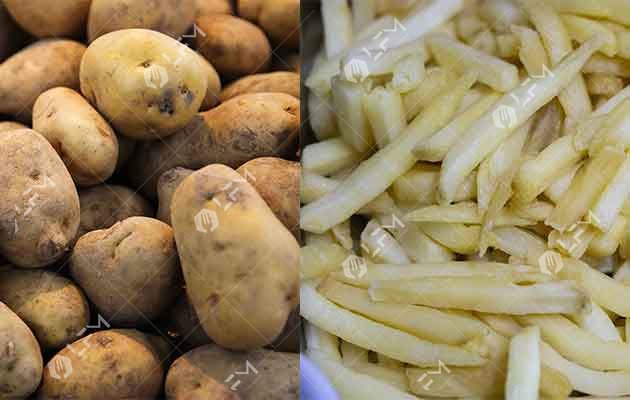
① Fresh Potato Selection: Selecting potatoes suitable for processing
Potato selection typically focuses on the following characteristics:
* Tuber size and shape
* Starch content
* Reducing sugar levels
* Moisture content
* Presence of mechanical damage
* Signs of sprouting, rotting, or greening
For french fries production, potatoes generally require good dry matter content and appropriate reducing sugar levels. Inconsistent raw material quality can lead to issues such as excessively dark color, a soft texture after frying, high oil content, or reduced product yield.
② Washing and Peeling
The primary purpose of washing is to remove:
* Soil
* Sand and grit
* Surface impurities
* Some microbial contaminants
If significant amounts of soil and sand remain on the potato surface, it can not only interfere with subsequent cutting and frying operations but also increase equipment wear and compromise food hygiene.
③ Trimming and Cutting
After peeling, the potatoes undergo trimming to remove any remaining skin, black spots, eyes, and obvious defects. They are then fed into the french fry cutter.
Depending on the final product specifications, fries can be produced in various sizes, such as:
* 7 × 7 mm
* 9 × 9 mm
* 10 × 10 mm
* 12 × 12 mm
Actual dimensions can be adjusted according to the customer's product specifications.
④ Rinsing: Rinsing to remove surface starch
After cutting, a significant amount of free starch remains on the surface of the potato strips. Without proper rinsing, the following issues may occur during the subsequent pre-frying process:
* Sticking together
* Uneven surface color
* Excessively dark frying color
* Excessive starch adhering to the surface
⑤ Blanching: A key processing step
The primary functions of blanching include:
* Modifying the internal structure of the fries
* Partially removing reducing sugars
* Improving the final color
* Stabilizing product quality
* Preparing the fries for the subsequent pre-frying stage
⑥ Drying: Dehydration prior to pre-frying
After pre-cooking, the surface of the potato strips retains moisture, necessitating a dehydration step. If the strips enter the frying equipment with excessive surface moisture, it can lead to:
* Oil temperature fluctuations
* Oil splashing
* Increased oil consumption
* Variations in the oil content of the strips
* Inconsistent pre-frying results
Therefore, drying is a crucial process linking pre-cooking and pre-frying.
⑦ Par-Frying: Pre-frying of industrial quick-frozen french fries
Pre-frying is a core step in the production of frozen french fries. Its purpose is to develop a specific surface structure on the product, rather than to cook it completely.
The pre-frying process requires control over:
* Oil temperature
* Frying time
* Conveyor speed
* Oil quality
* Potato strip feed rate
⑧ De-oiling: Removing oil after pre-frying
After pre-frying, french fries retain a certain amount of surface oil and must therefore undergo a de-oiling process.
Common methods include:
* Vibration de-oiling
* Air-blast de-oiling
* Centrifugal de-oiling
* Multi-stage combined de-oiling
The purpose of de-oiling is not only to reduce surface oil but also to improve the subsequent quick-freezing and packaging processes.
⑨ IQF Freezing: Rapid freezing of french fries
After pre-frying and de-oiling, the french fries are fed into the IQF (Individual Quick Freezing) equipment. The primary objective is to rapidly move the fries through a low-temperature freezing zone, bringing the product to a frozen state as quickly as possible to better preserve its structure and quality.
IQF equipment typically achieves continuous rapid freezing through:
* Cold air circulation
* Continuous mesh belt conveyance
* Temperature control
* Airflow control
* Freezing time control
⑩ Packaging
The automated packaging system performs the following operations based on preset weights:
* Quantitative weighing
* Automatic bagging
* Sealing
* Date printing
* Metal detection
* Finished product conveying
FAQ:
Q1:Do frozen french fries need to be fully fried before freezing?
Usually, it is not necessary. Frozen french fries are typically par-fried, then de-oiled and flash-frozen. Consumers or foodservice operators then perform the final frying or cooking before the product is served.
Q2:Why are potatoes blanched before frying?
Pre-cooking helps improve the color, texture, and subsequent frying performance of french fries, while also reducing certain color-affecting substances depending on the processing conditions.
Q3:What is the difference between fresh-cut fries and frozen french fries?
Fresh-cut fries are typically sold or further processed immediately after washing, peeling, and cutting; in contrast, frozen french fries undergo processes such as pre-cooking, pre-frying, and flash-freezing, making them better suited for long-distance transport, frozen storage, and distribution through foodservice and retail channels.
Related Product:
frozen french fries production line
The typical production process for quick-frozen french fries is as follows:
Fresh Potatoes → Sorting → Washing → Peeling → Cutting → Rinsing → Blanching → Drying → Par-Frying → De-oiling → IQF Freezing → Packaging → Cold Storage
Each step affects the appearance, texture, and storage stability of the final french fries.
① Fresh Potato Selection: Selecting potatoes suitable for processing
Potato selection typically focuses on the following characteristics:
* Tuber size and shape
* Starch content
* Reducing sugar levels
* Moisture content
* Presence of mechanical damage
* Signs of sprouting, rotting, or greening
For french fries production, potatoes generally require good dry matter content and appropriate reducing sugar levels. Inconsistent raw material quality can lead to issues such as excessively dark color, a soft texture after frying, high oil content, or reduced product yield.
② Washing and Peeling
The primary purpose of washing is to remove:
* Soil
* Sand and grit
* Surface impurities
* Some microbial contaminants
If significant amounts of soil and sand remain on the potato surface, it can not only interfere with subsequent cutting and frying operations but also increase equipment wear and compromise food hygiene.
③ Trimming and Cutting
After peeling, the potatoes undergo trimming to remove any remaining skin, black spots, eyes, and obvious defects. They are then fed into the french fry cutter.
Depending on the final product specifications, fries can be produced in various sizes, such as:
* 7 × 7 mm
* 9 × 9 mm
* 10 × 10 mm
* 12 × 12 mm
Actual dimensions can be adjusted according to the customer's product specifications.
④ Rinsing: Rinsing to remove surface starch
After cutting, a significant amount of free starch remains on the surface of the potato strips. Without proper rinsing, the following issues may occur during the subsequent pre-frying process:
* Sticking together
* Uneven surface color
* Excessively dark frying color
* Excessive starch adhering to the surface
⑤ Blanching: A key processing step
The primary functions of blanching include:
* Modifying the internal structure of the fries
* Partially removing reducing sugars
* Improving the final color
* Stabilizing product quality
* Preparing the fries for the subsequent pre-frying stage
⑥ Drying: Dehydration prior to pre-frying
After pre-cooking, the surface of the potato strips retains moisture, necessitating a dehydration step. If the strips enter the frying equipment with excessive surface moisture, it can lead to:
* Oil temperature fluctuations
* Oil splashing
* Increased oil consumption
* Variations in the oil content of the strips
* Inconsistent pre-frying results
Therefore, drying is a crucial process linking pre-cooking and pre-frying.
⑦ Par-Frying: Pre-frying of industrial quick-frozen french fries
Pre-frying is a core step in the production of frozen french fries. Its purpose is to develop a specific surface structure on the product, rather than to cook it completely.
The pre-frying process requires control over:
* Oil temperature
* Frying time
* Conveyor speed
* Oil quality
* Potato strip feed rate
⑧ De-oiling: Removing oil after pre-frying
After pre-frying, french fries retain a certain amount of surface oil and must therefore undergo a de-oiling process.
Common methods include:
* Vibration de-oiling
* Air-blast de-oiling
* Centrifugal de-oiling
* Multi-stage combined de-oiling
The purpose of de-oiling is not only to reduce surface oil but also to improve the subsequent quick-freezing and packaging processes.
⑨ IQF Freezing: Rapid freezing of french fries
After pre-frying and de-oiling, the french fries are fed into the IQF (Individual Quick Freezing) equipment. The primary objective is to rapidly move the fries through a low-temperature freezing zone, bringing the product to a frozen state as quickly as possible to better preserve its structure and quality.
IQF equipment typically achieves continuous rapid freezing through:
* Cold air circulation
* Continuous mesh belt conveyance
* Temperature control
* Airflow control
* Freezing time control
⑩ Packaging
The automated packaging system performs the following operations based on preset weights:
* Quantitative weighing
* Automatic bagging
* Sealing
* Date printing
* Metal detection
* Finished product conveying
FAQ:
Q1:Do frozen french fries need to be fully fried before freezing?
Usually, it is not necessary. Frozen french fries are typically par-fried, then de-oiled and flash-frozen. Consumers or foodservice operators then perform the final frying or cooking before the product is served.
Q2:Why are potatoes blanched before frying?
Pre-cooking helps improve the color, texture, and subsequent frying performance of french fries, while also reducing certain color-affecting substances depending on the processing conditions.
Q3:What is the difference between fresh-cut fries and frozen french fries?
Fresh-cut fries are typically sold or further processed immediately after washing, peeling, and cutting; in contrast, frozen french fries undergo processes such as pre-cooking, pre-frying, and flash-freezing, making them better suited for long-distance transport, frozen storage, and distribution through foodservice and retail channels.
Related Product:
frozen french fries production line
- Prev:Argentina Potato Chips Plant
- Next:None
Leave Your Message
If you are interested in our machine or any question, don't hesitate to contact us.