
What Is The Process to Make Chips?
Chips are a very popular snack, the hallmark of which is their crispness. So what is the process to make chips? We'll go into it in a moment.
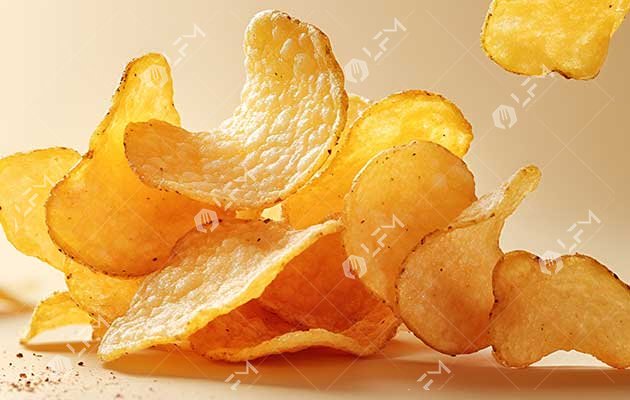
Main Production Process for Chips:
1. Raw Material Washing
Washing is the first step in the chips processing, its purpose being to remove soil, sand, stones and other impurities from the surface of the raw materials.
2. Peeling
After washing the raw materials go through a peeling process. Potatoes and sweet potatoes will generally be peeled to give a consistent colour and a better texture in the final product. The type of peeler (mechanical friction peeler etc) used will be dependent on the characteristics of the raw material and the production capacity required.
Cassava has a different skin structure to potatoes so a specific peeling technique has to be used for its particular outer and inner skins with care in the removal of any parts which are not edible. The right varieties have to be selected and the processing has to be in accordance with food safety requirements.
3. Slicing
After peeling the raw material is passed through a slicer to produce uniformly thick slices.
4. Rinsing
Following slicing the surface of the slices can become coated with some starch and small bits. Rinsing will remove some of the surface starch, reduce sticking between the slices and will also improve the appearance of the slices after frying.
Once rinsing is complete the excess water on the surface of the slices must be minimised. That way you don't have an excessive amount of water getting into the frying stage which could cause the oil temperature to fluctuate and result in oil splashing.
5. Blanching
Blanching is a pre-treatment used in some chips processing lines. The raw material is subjected to a controlled water temperature and processing time which will moderately alter the internal structure of the material and will also serve to reduce the activity of certain enzymes thus minimising the potential for quality variation during the subsequent processing.
6. Frying
Frying is the key step that gives the chips their crispness. As the chips are heated the moisture within them slowly evaporates and their structure changes, leading to a crisp product with a porous structure.
7. De-oiling and Cooling
After frying, a certain amount of cooking oil will be present on the surface of the chips. A de-oiling machine is used to remove this excess surface oil, which in turn reduces the greasiness of the final product.
The chips have to be cooled appropriately at this stage to bring their temperature down gradually in preparation for the subsequent seasoning and packaging. During the cooling process environmental hygiene must be meticulously observed to prevent any condensation of moisture or ingress of external humidity into the product.
What needs to be considered during the chips manufacturing process?
1. Select the appropriate processing parameters according to the raw materials. Potatoes, sweet potatoes and cassava all differ in terms of their starch content, sugar content, moisture content and structure. Prior to commencing production you should test your raw materials and establish your own standards for slice thickness, pre-treatment and frying.
2. Ensure uniform slice thickness. If the slices are of inconsistent thickness they will dehydrate at different rates and you'll end up with some chips crisp and some not.
3. Control the frying temperature and time. If the oil is too cold the chips will take in too much oil, if it's too hot they will go dark and possibly develop some localised charring. The manufacturer will of course have to set these parameters according to their own equipment, their product and the condition of the raw materials.
4. Manage the moisture levels effectively. After rinsing and blanching the raw material the surface moisture must be properly controlled and after frying it is essential to get the product to the required moisture level. If the product is packaged too early or if it is packaged in a high humidity environment the chips will lose their crispness.
- Prev:Centrifugal Deoiling Machine Working Principle
- Next:None
Leave Your Message
If you are interested in our machine or any question, don't hesitate to contact us.